There are several English words that are misused and applied interchangeably in sentences and conversations. Some examples of these words include the terms ““Bemused” and “Amused.” The word “bemused” is defined as being in a state of confusion or bewilderment. It is the feeling of being lost in thought or reverie. The word “bemused” additionally means having or showing feelings of wry amusement, especially at something that is surprising or perplexing. The term “amused” on the other hand, is defined as being pleasantly entertained or diverted by something that is quite hilarious. It is the act of feeling or showing amusement. The similarity of the words “bemused” and “amused” llies in their grammar form and nature of indication. The terms “bemused” and “amused” are both adjectives, and both pertain to human feelings. “Bemused” and “amused” become undeniably distinct in terms of their definition. There is a visible difference when it comes to logography as well, even though they almost have the same spellings. It is crucial to have a clear comprehension of the annotations and uses of these words in order to create quality and accurate content.
The differences and comparison of the words “bemused” and “amused” are listed below.
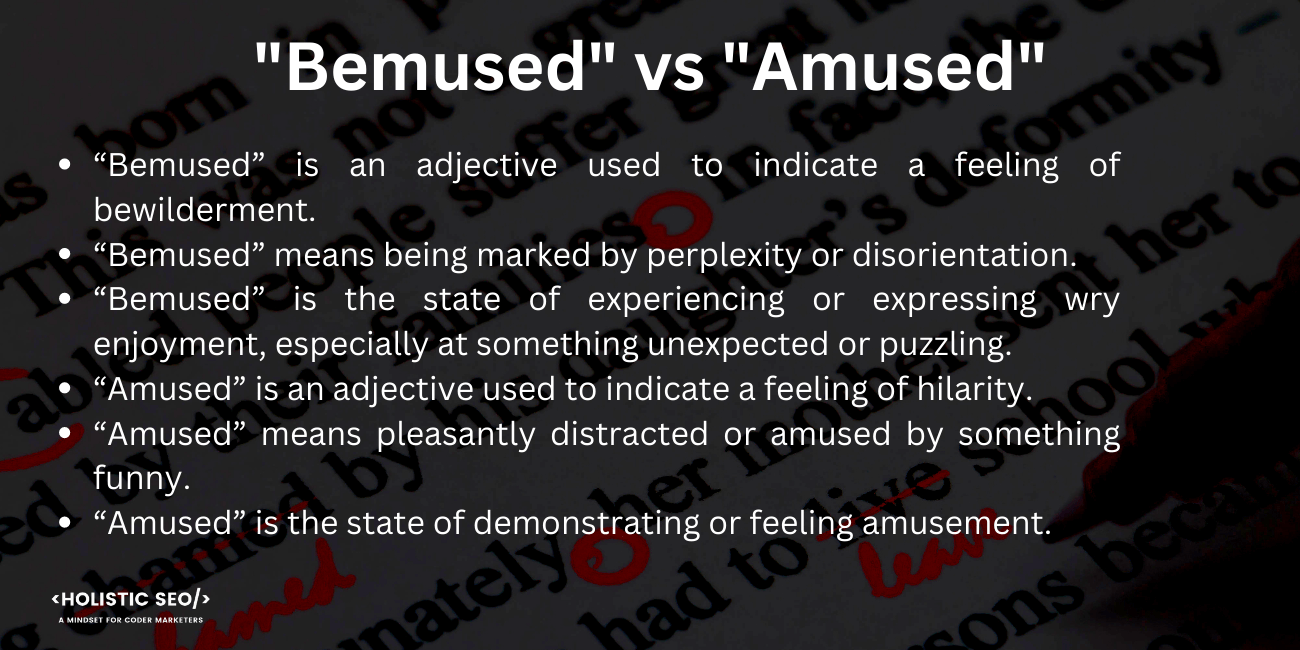
- “Bemused” is an adjective used to indicate a feeling of bewilderment.
- “Bemused” means being marked by perplexity or disorientation.
- “Bemused” is the state of experiencing or expressing wry enjoyment, especially at something unexpected or puzzling.
- “Amused” is an adjective used to indicate a feeling of hilarity.
- “Amused” means pleasantly distracted or amused by something funny.
- “Amused” is the state of demonstrating or feeling amusement.
Many speakers and writers have been asking about how to decide to use the words “bemused” and “amused” in a sentence. The answer behind that is by knowing the correct definition and usage of each word. The words “bemused” and “amused” are considered confusing, especially because they almost have the same pronunciation and spelling. However, having enough knowledge about their meanings and the grammar forms from which they are supposed to be used, a person is able to come up with appropriate and relevant sentences.
The example sentences that illustrate the proper application of the word “bemused” in a sentence are as follows, “Mr. Murphy was looking at the boys with a bemused expression.” and “He was staring bemusedly at the picture of himself.” The word “bemused” is grammatically correct as applied in the sentences. The term “bemused” in the first sentence is in an adjective form, indicating a feeling of bafflement. It expresses an idea about the subject as having an impression of confusion towards some boys. The second sentence uses the word “bemused” in an adverb form, describing the verb stare or staring as presented in the sentence. It indicates that the subject is staring at a certain material while being puzzled about it. The sentence examples for the “amused” as employed in a sentence are the following, “If you are amused by something, it makes you want to laugh or smile.” and “We were amused to see how assiduously the animal groomed its fur.” The word “amused” is properly used in both sentences. It is grammatically correct in the first sentence as an adjective, indicating a superb feeling of glee. The first sentence made use of the word “amused” by simply describing it. The term “amused” is employed in the second sentence to indicate the state of merriment that the subject experienced from witnessing an animal who diligently groomed itself.
A lot of speakers and writers are wondering about why there is a need to know the difference between the words “bemused” and “amused” for content writing and marketing. The reason behind that is for content writers and marketers to be able to write better content and communicate in a healthier way. The words “bemused” and “amused” are undeniably confusing when a person holds unfamiliarity towards the words. The ambiguity in the knowledge of the words “bemused” and “amused” is capable of leading writers and speakers to commit errors while writing and speaking. It is important to know the correct differences and similarities of these words in order to avoid such inaccuracies.
What does “Bemused” Mean?
The word “bemused” refers to the state of experiencing or expressing wry enjoyment, especially at something unexpected or puzzling. It is generally described as being confused and bewildered at something. The word “bemused” is presented as a past participle adjective that is used to modify a noun. The term “bemused” originated from the combined words “be” and “muse”. Its first known use was noted in the year 1734. However, it was recorded a year later in 1735. The term “bemused” was believed to have been likely used earlier, as the Pope described it as “devoted wholly to the Muses” in the year 1705. The term ”bemused” was widely acknowledged during the middle of the 18th century. “Bemused” is described as the act of showing that a person is confused and unable to think clearly, according to Oxford Learner’s Dictionaries. The term “bemused” is a common word in English. It is a typical English term that is used in official and informal contexts.
The word “bemused” is applied to sentences or conversations to indicate a condition of mental confusion or preoccupation. It is frequently used to describe someone who is deeply contemplating something or who is puzzled or mystified by something. It additionally signifies a sardonic disinterest in the situation or a hint of faint enjoyment. The term “bemused” is an important word for daily life because it enables people to express a wide variety of emotions or mental states. It is usually employed in sentences and conversations to portray a feeling of ambiguity, confusion, or detachment, which is helpful in a wide range of circumstances. It has the potential to be used to characterize someone who is attempting to understand a complex issue or a perplexing circumstance as well. The word “bemused” is additionally viable to be used in characterizing someone who is aloofly curiously viewing an odd or uncommon incident. The term “bemused” offers people’s communication with a rich feeling of meaning and depth, overall.
What are the sentence examples with “Bemused”?
Listed below are the sentence examples for the word “bemused.”
- “The pupil gave him a rather bemused look before saying that he had been ill last night and preferred the pizzas.” The word “bemused” is employed in the sentence in a past participle adjective form, indicating a feeling of puzzlement or confusion. The sentence expresses a thought that the subject expresses a confused facade to a certain person prior to answering a particular question or inquiry from another entity.
- “The first ad features editorial staff reading critical tweets in a bemused fashion.” The sentence illustrates that a particular advertisement is depicting a picture of a staff member showing a puzzled expression while reading a message on Twitter. The word “bemused” is used in the sentence as an adjective modifying or describing the noun “fashion”.
- “He says that for most of his twenties his parents were bemused rather than anxious or intolerant.” The word “bemused” is incorporated in the sentence as an adjective, indicating a feeling of bewilderment. The sentence expresses an idea that the subject’s parents are wryly perplexed about how their child acted when he reached the age of twenty to twenty-nine.
- “His finding that only three players were involved in the issue left many bemused.” The term “bemused” is used in the sentence in the form of a past participle adjective. It denotes a state of feeling or showing puzzlement towards a particular subject. The word “bemused” as applied in the sentence indicates the feedback of other entities towards the subject’s findings for a particular issue.
When to use the word “Bemused” in a sentence?
The word “bemused” is used in a sentence when indicating or expressing a feeling of ironic bewilderment. It is used to describe a person who is attentively lost in their own thoughts, or who is baffled or bewildered by something. The word “bemused” additionally signifies a sardonic disinterest in the situation or a hint of faint enjoyment. It is an adjective that is helpful in a wide range of circumstances since it conveys a feeling of uncertainty, confusion, or detachment. The word “bemused” is frequently used when someone is attempting to comprehend a complicated or challenging issue or circumstance. It is used, for example, to describe a scientist trying to understand a recent discovery or an engineer seeking to resolve a technical issue, for instance. It is additionally used to describe someone who is attempting to comprehend a complex notion or subject.
The word ‘bemused” is a good word to characterize someone who is aloofly curiously viewing an odd or uncommon incident. It is used, for instance, to describe someone who is puzzled while observing a strange performance or show. It is utilized to describe someone who is aloofly observing an odd or bizarre incident and is unsure of how to react to it. The word “bemused” is employed in sentences and conversations in a social context to describe someone who is wryly detached from or mildly amused by a situation. It has the potential to be used in describing someone who is amused by the scenario rather than laughing when watching a comedy. The word “bemused” is applicable as well to describe someone who is seeing something funny or amusing from a distance and is unsure of how to react to it.
The term “bemused” is adaptable and is applicable in a variety of contexts. It is used to characterize someone who is trying to comprehend a complex issue or circumstance, someone who is aloofly curiously observing an odd or uncommon incident, or someone who is somewhat amused or removed from a situation. It gives communication a rich feeling of significance and depth and is viable to be employed in both official and informal contexts. The word “bemused” must not be utilized when referring to a state of feeling of superb delight or gladness because it is incorrect. The right word to be used for such a description is “amused.”
One of the known synonyms of the word “bemused” is “addled”. The word “Addled” is described as to throw into confusion or to become confused. It is used as an alternative word for the term “bemused”. The word “addled” is correctly used in a sentence, as illustrated in the sentence such as “The instructions were so poorly written that they only served to addle the already confused customer.” The word “addled” is a verb which means to confound or muddle anything, as well as to drive someone or something insane. Additionally, it indicates to ruin or ruin anything. However, it is less frequently used and is generally seen as being more literary or antiquated than words with comparable connotations like “confuse” or “befuddle.” It is important that a speaker or writer knows how to use the word “bemused” in a sentence or in a conversation. One must remember that the term “bemused” is used when referring to or expressing a feeling of ironic puzzlement and not when referring to or expressing a feeling of merriment.
How often is the word “Bemused” used in a sentence?
The word “bemused” is used in a sentence depending on a number of variables, including the context, the target audience, and the media format. The term”bemused” is generally regarded as a common word in English usage, although it is not used as frequently as terms like “happy,” “sad,” or “angry.” The word “bemused” appears more commonly in written literature like novels, essays, and newspapers than it does in spoken English. It is so that meaning is conveyed in written documents, which frequently require more exact and nuanced terminology. It is additionally viable to add complexity to the characters or the plot in writing by evoking a feeling of ambiguity, confusion, or detachment.
The word “bemused” is able to suggest self-reflection or introspection in a character, or to introduce ambiguity or confusion into a story. Another prominent usage of the word “bemused” is in spoken language. However, the word “bemused” is used less frequently in spoken English than it is in written texts, although it is still regarded as a popular word. It is sometimes used in conversation to express uncertainty, perplexity, or detachment or to describe a person’s mental condition. The context of the conversation and the participants is able to influence how often the word “bemused” is used in speech. It is used more frequently, for instance, in interactions between people with greater education or in contexts that are more formal, such as business meetings or intellectual discussions. “Bemused” is viable to be used in a variety of ways, depending on the type of media used. The word is often used, for example, to describe how people react to specific events in written news stories, but less usually used in spoken news. The word has the potential to be used less frequently on social media than in formal writing. The word “bemused” is nevertheless regarded as a common word in the English language, although it is not often used as frequently as certain other terms. It is a flexible word that is viable to be employed in a wide range of contexts and is capable of providing communication with a deep feeling of meaning.
What are the synonyms of “Bemused”?
The most common synonyms for the word “bemused” include “bewildered,” “befuddled,” and “confused.” These words are used alternatively in a sentence or conversation to indicate the same meaning as the word “bemused.” The term “bewildered” is referred to as the state of being deeply or utterly confused or perplexed, while the term “befuddled” means being utterly confused or puzzled or deeply perplexed. Moreover, the word “confused” is described as the state of being disoriented when it comes to one’s sense of time, place, and identity. The words “bewildered”, “befuddled”, and “confused” are applicable when referring to or expressing a notion of doubt or disbelief towards something or someone that seems out of context or unusual. The sentence examples illustrating the proper usage of the word “bewildered” are the following, “The bewildered (bemused) anthropologist is one of the first to gather remains from the Toxodon species called platensis.” and “The man addressed the statement at the presscon, looking somewhat bewildered (bemused).”
The sentence examples for the correct application of the word “befuddled” are as follows, “Perhaps that global pecking order is one of the reasons why U.S. swimmers looked more befuddled (bemused) and sad than aggrieved or critical of the penalty decision.” and “The military goes on high alert while the intelligence services spring into befuddled (bemused) action after the hijack threat towards the presidential aero service.” Furthermore, the example sentences for proper utilization of the word “confused” are the following, “Steven said the artificial corpse found in the river looked exactly like a real dead body, which is why the police were confused at first.” and “John was confused to begin with, having no idea why he was pointed out.” There are other variations for the word “bemused.” Some of these words include “dazed,” “befogged,” and “confounded.” These words are viable to be used as an alternative term to the word “bemused”. However, it requires that these words are used in a proper manner and correct grammar form to communicate with others in an effective way.
What does “Amused” Mean?
The word “amused” refers to the state of being pleasantly entertained or diverted by humor. The term “amused” is additionally described as being pleasantly distracted or amused by something funny. It is the past participle adjective of the word “amuse” implying the condition of being pleasantly occupied or entertained. The origin of the word “amuse” is derived from the Middle French word “amuser” which means to divert the attention, to beguile, or to delude, literally used in sentences and conversations to express distraction during the latter part of the 15th century. Its etymology states that the word “amused” was a combination of the words ”a” which means “at or to” in Latin and the term “muser” which denotes “ponder, or stare fixedly.” It was not regularly used before the year 1600s and was not found administered on Skaepeare’s works. The word “amuser” was given the definition “to divert from serious business or tickle the fancy of” in the 1630s. However, its meaning was altered into “to deceive or cheat ” during the 18th century. The first known use of the word “amuse” came to surface in the year 1728. “Amused” is defined as the act of thinking that somebody or something is funny, so that one results to smile or to laugh, according to the Oxford Learner’s Dictionaries.
The term “amused” is a common word in English because it is crucial for conveying sentiments and emotions. It is used to express the emotional state of characters and the audience in a number of circumstances, from everyday speech to literature and media. The word “amused” is an everyday term in English. It is a verb that expresses the sensation of finding something amusing or entertaining. It is frequently used to show that someone is amused at a certain point in the past, in the past participle form “amused.” The word “amused” is properly used in a sentence such as, “I found the comedian’s quips amusing,” or “The kids found the clown’s antics amusing.” The term “amused” is indeed an important word for daily life. It is used to express the sensation of finding something amusing or entertaining. People frequently use the word “amused” in social contexts to convey how much they are enjoying a certain circumstance or activity, and when they find jokes or talk interesting. It helps individuals connect and understand one another by allowing them to express their emotions and feelings, which play a significant role in language.
What are the sentence examples with “Amused”?
Listed below are some of the sentence examples of the word “amused.”
- “Social media has been noisy this week about the audience’s amused reactions to the show’s capabilities after its unexpected shortcomings.” The word “amused” is used in the sentence as an adjective in a past participle form. The word “amused” indicates a feeling of humor towards a particular event or thing. It is applied in the sentence indicating that the subject of the statement seemed entertained by a recent event in the past.
- “The amused sourdoughs influenced Englishmen to try the local brew of an ice worm cocktail.” The word “amused” is properly used in the sentence to indicate a notion of delightment. It is applied in the sentence as an adjective modifying the noun sourdoughs. The sentence expresses an idea that the sourdough’s state of being delighted or being amused was able to affect the decision of Englishmen to prefer a different product.
- “Players from both teams occasionally looked a bit amused as their scene partners said something particularly hilarious during the break.” The term “amused” is correctly utilized in the sentence to express a feeling of amusement towards a certain entity. The sentence illustrates that the subjects are entertained by what they witness from their scene partners. The term “amused” is used in the sentence in an adjective format.
- “The wedding gown is handed down from mother to daughter with the father’s amused attention.” The term “amused” is used in an adjective format, which is applied in the sentence to modify or describe the noun “attention.” “Amused” is the state of being entertained or being glad towards a particular thing, person, or event. It clearly indicates that a certain entity in the sentence has expressed a notion of delightment towards the subject.
When to use the word “Amused” in a sentence?
The word “amused” is used in a sentence when referring to or expressing a feeling of delightment or gladness towards another entity. The word “amused” is an adjective used to describe anything or someone that is in the state of experiencing entertainment pleasure. The phrase is frequently used to indicate that someone finds something humorous or amusing. The word “amused” is sometimes used to convey slight interest or enjoyment as opposed to full laughter or joy as well, for example, in events like watching a particular movie that wasn’t humorous or interesting enough, but is still able to retain one’s attention and keep a person entertained. A person’s attitude or expression is described with the use of the word “amused” as well, for instance, in conveying a person’s apprehension towards another person’s conduct. It is important to remember that the term “amused” has a favorable meaning and suggests that the subject is having fun. The term “amused” is frequently employed in sentences and conversations to indicate that someone finds something amusing or hilarious, as well as to characterize a person’s expression or manner. It has a pleasant connotation and suggests that the topic is having fun. The word “amused” must not be used in sentences or conversation that express a feeling of puzzlement or confusion. The right word for such ideas is the term “bemused”.
One of the noted synonyms of the word “amused” is the term “entertain”. The word “entertain” is a verb that refers to the act of causing delightment or gladness to someone. It is used as an alternative word for the term “amused.” “Entertain” is applicable to sentences and conversation that expresses an idea of providing entertainment or enjoyment to others. It is viable to be applied to sentences that denote being a polite host or extending hospitality. The term “entertain” is additionally employed as a more inclusive term to refer to any endeavor intended to keep a person interested or involved. It is important to remember that the word “amused” must not be used to denote a feeling of bewilderment. It must not be applied to sentences that express ideas such as confusion or doubt as well.
How often is the word “Amused” used in a sentence?
The word “amused” is used in a sentence depending on the context and the specific source of text. Nevertheless, the term “amused” is a more prominent word compared to the term “bemused.” It is a frequently used word that appears in a wide range of texts, including novels, essays, and discussions. “Amused” is applied in the areas of literature to explain a character’s response to a specific circumstance or occurrence, such as novels. It is utilized in the fields of news articles and other non-fiction writing, as well, to indicate a person’s reaction to a particular event or situation. The term “amused” is additionally employed in casual conversations at the same time when it is utilized to express how someone feels about something that they find amusing or engaging. The word “amused” is utilized in academic or formal writing as well to indicate a person’s response to a specific event, notion, or idea. The term “amused” is generally used to describe a person’s response to something they find humorous or entertaining in a variety of text types and circumstances. It has a pleasant connotation and suggests that the topic is having fun. Speakers and writers are encouraged to have the right knowledge as to how the word “amused” must be used in a sentence or in a normal conversation.
What are the synonyms of “Amused”?
There are certain words that are synonymous to the term “amused”. Some of these words include “delighted,” “pleased,” and “tickled.” These words are viable to be applied in sentences and conversations instead of the word “amused.” However, there are certain factors that need to be considered when using the following terms. The term “delighted” is referred to as the condition of experiencing pleasure, satisfaction, and delight. The word “pleased” on the other hand, refers to the state of being delighted. It is described as the condition where one runs into delight and joy, just like the word “delighted.” The word “tickled” furthermore, is referred to as the condition where a person feels so much delight and pleasure towards certain things just like the words “delighted,” and “pleased.” Its literal meaning describes a light tingling or itchy sensation that is brought on by a light touch to the skin or another sensitive area, such as the armpit or the bottom of the foot. The sensation is frequently accompanied by laughing or a sense of pleasure.
The sentence examples that showcase the usage of the word ”delighted” are as follows, “The children were especially delighted (amused) to know that there were enough candies for each of them to have two.” and “Not everyone in the organization was delighted (amused) with their booming rivalry, including the president herself, according to some claims.” The term “delighted” is used in the sentences to describe someone who is overjoyed or exceedingly satisfied with something. It is frequently used to convey a high level of pleasure or satisfaction and suggests that the speaker is feeling happy, content, or excited. The example sentences for the word “pleased,” on the other hand, are the following, “His parents were pleased (amused) by her decision to continue a degree in medicine.” and “Thousands of directors make a living on their own terms every day while getting their audiences pleased (amused) about their output. The term “pleased” is applied in the sentences to indicate someone who is content or delighted with something. It means that as a result of an occurrence or circumstance, the person is feeling positively, such as happiness or satisfaction. It conveys a nice sense, but is not as powerful as “delighted.” Moreover, the sentence examples that illustrates the correct application of the word tickle in sentences are as follows, “The treasures that tickle her most are drawings by children, especially those that paint a clear picture of what might be going on in their lives, despite the simplicity of the artwork.” and “We were tickled by the invitation to attend the reunion after hearing negative feedback from the committee.” The word “tickled,” as employed in the sentences, convey a metaphor of real tickle. It expresses an idea that the subject is experiencing amusement caused by physical tickles. It is sometimes used as a verb to describe the act of tickling someone. These words are actually viable to be used interchangeably in sentence construction and English conversations. However, it is crucial to consider that each word must be used according to its corresponding format and meaning. Some other variations of the word “amused” involve the terms “appeased”, “enthralled”, and “engrossed. These words, however, hold a little distinction to the term “amused.” It is important to know the correct meaning and grammar usage of these words before incorporating them into sentences and conversations.
How is the pronunciation of “Bemused” and “Amused”?
The pronunciation of the words “bemused” and “amused” is quite identical at first glance. However, people are able to identify its distinctive properties in terms of pronunciation with further apprehension. The word “bemused” is composed of two syllables “be” and “mused.” The pronunciation of the first syllable and prefix “be” is /bɪ/. The second syllable “mused” is pronounced as /mjuːzd/. The overall pronunciation of the word “bemused” is /bɪˈmjuːzd/ with the emphasis on the 2nd syllable “mused” or /mjuːzd/. “Bemused” is defined as the state to be perplexed, confused or lost in thought. The word “amused” similarly, comprises two syllables which are the prefix “a” and the term “mused.” The pronunciation of the word “amused” is uttered as /əˈmjuːz/. The first syllable “a” is uttered as /ə/ as in “apple” while the second syllable “muse” is articulated as /mjuːz/ as in “choose.” The “d” at the end denotes the past tense, and the word is pronounced as /əˈmjuːzd/. “Amused” refers to the condition of experiencing amusement or humor from particular entities.
Comparison between “Bemused” and “Amused”
Illustrated below is a table showing the comparison between the words “bemused” and “amused.”
| English Words | Definition | Context | Examples |
| Bemused | The word “bemused” is an adjective used to indicate a feeling of bewilderment | The word “bemused” is used to indicate or express the state of experiencing bewilderment or confusion towards a particular thing, person, or event. | “He says that for most of his twenties his parents were bemused rather than anxious or intolerant.” “He was staring bemusedly at the picture of himself.” |
| Amused | The word “amused” is an adjective used to indicate a feeling of hilarity. | The word “amused” is used to describe or express the state of experiencing entertainment pleasure or delightment towards something or someone that is humorous or amusing. | “Players from both teams occasionally looked a bit amused as their scene partners said something particularly hilarious during the break.” “We were amused to see how assiduously the animal groomed its fur.” |
Why are “Bemused” and “Amused” misused interchangeably in English?
The words “bemused” and “amused” are often misused and applied interchangeably in English due to a few reasons. One of the reasons why these words are misused is because of their almost similar pronunciation. The pronunciation of the words” bemused” and “amused” has minimal distinction. These words are anticipated to sound the same from a distant conversation. However, the differences of the words “bemused” and “amused” is quite visible when written down or brought in an encoded manner. The sole distinction that these words have in terms of the pronunciation lies in their first syllables. The word “bemused” is composed of two syllables “be” and “muse”. An additional letter “d” is added to the word to emphasize its form as a past participle word. The word “bemused” is articulated as /bɪˈmjuːzd/. The term “amused” similarly comprises two syllables, just like the word “bemused”. It has the same second syllable to the word “bemused” as well. However, its first syllable is “a” instead of “be”. A supplemental letter “d” is added to the word “amused” to indicate that it is in a past participle form of the verb. The term “amused” is articulated as /əˈmjuːzd/. Another thing that causes the words “bemused” and “amused” to be applied interchangeably in a sentence is because of spelling. There is a minimal distinction for the words “bemused” and “amused” as well. The distinction is spelling solely lies in the first syllables of the words. The word “bemused” is spelled out as ”b-e-m-u-s-e-d” while the term “amused” is spelled as “a-m-u-s-e-d.” The first one to three letters of the words “bemused” and “amused” creates the specific distinction of the word. It often results in the misuse of the words in the sentences.
There are instances where people learn the words “bemused” and “amused” together and still get confused. The reason behind that lies on a number of factors. Some of these factors include the nature of the words “bemused” and “amused”. These words both describe a feeling. “Bemused” describes a feeling of confusion and wonder, while “amused” describes a feeling of amusement or delight. Although these words refer to two different things, most people find it confusing to apply them correctly in sentences because of it. Another factor is the similarity in spelling and pronunciation. It is easy to get confused with the words “bemused” with “amused” because they have a similar pronunciation and spelling, causing difficulties. The lack of comprehension to correct context is additionally a factor which leads most people to misused these words.
People who lack sufficient background or examples to completely comprehend the two words’ slight semantic differences often find themselves using the wrong word in their sentences. It is essential to comprehend the minute semantic variations between the two words and to practice using them correctly in various settings, to prevent misunderstandings. Looking for instances in context and paying close attention to the details, additionally aid in comprehending and remembering the words’ intended meanings.
Are “Bemused” and “Amused” in the most commonly misused English words?
Yes, the words “bemused” and “amused” are some of the most commonly misused words in English. These words are misused due to some reasons such as their minimal difference in spelling and their close sounding pronunciation. The words “bemused” and “amused” have the same nature of purpose as well. These words are both in adjective forms and are both used to describe particular feelings or notions. The word” bemused” indicates a feeling of bewilderment, while the term “amused” indicates a feeling of amusement. Some English words are misused by having several meanings, such as the word “set.” There are English words that are misused because of having the same definition as well. It is crucial to be aware of the frequently misused English words and pay close attention to their proper usage to prevent misunderstanding or misinterpretation of the intended thoughts or ideas.
What are the other similar Misused Word Pairs like “Amused” and “Bemused” in English?
Listed below are some of the other misused word pairs in English that are similar to the words “bemused” and “amused”
- “Imply” vs “Infer”: The words “imply” and “infer” are similar to the words “bemused” and “amused” because they are often misused in sentences and conversations. The word “imply” indicates that the subject is the one giving out the information. On the contrary, the word” infer” indicates that the subject is the one receiving the information. The words “imply” and “infer” both have a significance in terms of information dissemination. However, they have distinct and specific definitions. It is one of the reasons why these words are misused in sentences.
- “Eminent” vs “Imminent”: The terms”eminent” and “imminent” are another example of misused words in English, just like “bemused” and “amused.” The word “eminent” means well-known or exceptional, while the word “imminent” means a thing or event that is about to take place. These words have a slight difference in terms of spelling, and sound almost the same. It is the reason why the words “eminent” and “imminent” are applied interchangeably in sentences and conversations.
- “Advice” vs “Advise”: Another misused word pair that is similar to the words “bemused” and “amused” are the terms “advice” and “advise.” The word “advice” refers to the information or a set of reminders given out by someone, while the term “advise” refers to the act of giving out a set of instructions or guidelines. These words are associated in the same context and have the same pronunciation. The differences that they have against each other is their one-letter distinction and their grammar form. The word “advice” is a noun, whereas the word “advise” is a verb. These are the reasons why these words are often misused in sentences and conversations.
- “Altogether” vs “All together”: The words “altogether” and “all together” are misused English words that are similar to “bemused” and “amused.” The word “altogether” is an adverb which means wholly, while the word “all together” is a phrase which denotes all in one place. These words have a minimal difference when it comes to spelling and sound exactly the same. Most people misuse these words because of these reasons.
These are some of the English word pairs that are misused and applied interchangeably in sentences and conversations. Most word pairs differ from each other in terms of meaning and spelling. These are the main indications that every writer and speaker must think about when applying the misused word pairs in English.
What are the things should a content writer consider in using the word “Bemused” and “Amused”?
There are things to consider when writing and using the words “Bemused” and “Amused” in sentences and conversations. The words “bemused” and “amused” are some of the English terms that are usually misused nowadays. These words are often confused because of their close similarities and minimal differences in terms of spelling, grammar, pronunciation, definition , and sometimes grammar. One of the things that speakers and writers must consider in using the words “bemused” and “amused” is the grammar. It is important to bear in mind that the terms “bemused” and “amused” are both adjectives. They are the past participle form of the verbs “bemuse” and “amuse” respectively. These words are viable to be used in other forms as an adverb, a noun, and as a verb, but with required alterations of the words themselves. The terms “bemused” and “amused” are used as an adverb by adding a suffix “ly” to the end of the words, as in “bemusedly” and “amusedly.” These words are used as a noun by placing a different suffix which is “ment”, as in “bemusement” and “amusement.” Furthermore, they are viable to be used as a verb by removing the letter “d” to present them as a present active verb. Another thing that must be pondered is the definition of each word. There is a slight difference for each term in terms of definition. However, it plays a big role in determining which word must be used in a sentence or conversation. The word ‘bemused” is used to indicate a feeling of puzzlement. It is the state of being confused or doubtful about a certain entity. The term “amused” on the other hand, is used to indicate a feeling of entertainment or enjoyment. It is the state of being delighted or pleased about a particular thing, person, or activity. It is very important to have the right knowledge about the words “bemused” and “amused” in order to come up with quality and accurate content.
Can content writers use “Bemused” and “Amused” in one sentence?
Yes, the words “bemused” and “amused” are viable to be used in one sentence. However, it is essential to use the proper grammar forms of the words to function harmoniously in one sentence. The words “bemused” and “amused” have significantly distinct meanings, although they share a connection with the idea of enjoying something or finding it hilarious. “Bemused” means being confused or perplexed, while “amused” means being entertained or tickled. Some example sentences where the words “bemused” and “amused” are employed are as follows, “The audience was bemused by the clown’s expertise and amused by his antics as he juggled the chainsaws.” and “ She was bemused by the story’s unexpected plot twist, but nonetheless amused by the brilliant writing.” The word “bemused” is grammatically wrong when used to describe a particular verb in a sentence. It must be altered into “bemusedly” to fit in the sentence in such cases. The word “amused” is the same way erroneous when applied in the sentence as a noun or verb. It must be amended with a suffix “ment” to be used as a noun. Additionally, it must be removed from the supplemental letter “d” in order to use it as an active verb. The terms “bemused” and “amused” are viable to be combined to describe a person’s responses to a circumstance. These terms are allowed to be used in one sentence, provided that the grammar forms are correctly applied, and the idea is properly arranged.
How do Content Writers use “Bemused” and “Amused” in their articles?
Content writers use the words “bemused” and “amused” in their to communicate ideas or to describe the feelings and responses of the people or subjects they are writing about. Content writers are able to use the words” bemused” and “amused” when writing about certain topics such as comedy events, news stories, fiction, or making reviews. These words are suitable for contexts where the speaker or writer is attempting to communicate the feelings or responses of an individual or group of individuals to a certain circumstance or event. These words have a very minimal distinction from each other, which causes a lot of people to misuse them oftentimes. Content writers must be able to distinguish which word is the right term to be used in their sentences. The term “bemused” is applicable when referring to a notion of being puzzled about something, while the term “amused” is applicable when referring to a condition of being entertained. It is important for content writers to know the difference between the words “bemused” and “amused” because ignorance of these words lead to misuse and confusion. Confusion on the part of content writers produces content writing that contain uncertain ideas as well.
Content writers are advised to have the ability to determine which term must be used in their sentences with respect to the idea that they are trying to convey and to the correct grammar form that must be applied.
Do Content Writers use “Bemused” and “Amused” in the wrong way?
Yes, content writers use the words “bemused” and “amused” in the wrong way in some instances. It is critical for content writers to be aware of the meaning of the words they employ, in order to communicate the appropriate tone and message to the readers. It is expected to confuse the reader and convey the wrong impression, when a writer uses “bemused” instead of “amused” or vice versa. Content writers must remember that most English words have many meanings depending on the situation and culture. It is always a good idea for content writers to check the definitions of such words before employing them in their sentences. Reviewing one’s writing and paying attention to the words used, particularly those that may have several meanings, is a useful writing habit that every content writer must practice. Additionally, content writers must be cautious in using idioms and colloquial expressions, as they have the potential to be readily misapplied or misunderstood in a particular sentence. They must be used appropriately and in a way that the intended audience easily understands. Content writers have a great advantage in knowing the things that must be done and must not be done in Content Writing. Quality and accurate contents are produced when a content writer applies the habit of knowing and applying the correct usage of misused English words.
Do Misused Words such as “Amused” and “Bemused” affect SEO and UX?
Yes, misused words such as “amused” and “bemused” affect SEO and UX. Using certain English words in a wrong way is detrimental in both of these contexts. It is essential to use the right terms in content writing for both UX or User Experience and SEO or Search Engine Optimization. The use of incorrect words affects SEO by preventing articles from showing up in search results whenever an inquiry is performed in a particular search engine like Google, Bing, or Firefox. Search engines use algorithms to determine the relevance of information to a search query. Using the incorrect phrases or words make it challenging for the algorithm to understand the topic of the content. The visibility and traffic to a certain website suffer as a result of contents being ranked lower in search results. Furthermore, the application of misused words such as “bemused” and “amused” is able to influence the UX or user experience in a way that it brings confusion to the users. It is expected to bring a challenge for readers to comprehend or engage with the message if a content writer uses the wrong term to convey such ideas. It results in a bad user experience, causing readers less likely to visit the website again or interact with the material in the future. Content writers must invest time in choosing the appropriate words for their content and proofreading their work to make sure that the right words are being utilized. It is anticipated to assist content writers in producing articles that are both user and SEO friendly, while enhancing the functionality of the website as a whole and boosting reader engagement at the same time.

- 48 Online Shopping and Consumer Behavior Statistics, Facts and Trends - August 22, 2023
- B2B Marketing Statistics - August 22, 2023
- 38 Podcast Statistics, Facts, and Trends - August 22, 2023