A lot of English words today are improperly used for sentence construction and verbal communication. Some words are mistakenly used for their spelling, pronunciation, and definition. One of these words are the “allusion” and “illusion. “Allusion” is an expression to refer to something without mentioning it directly. Meanwhile, the “illusion” is anything perceived or interpreted in a wrong manner. “Allusion” makes use of obscure words and phrases to tap a person, thing, place or situation. “Illusion” makes use of images, graphics, memories, and emotions to display something that is not real or doesn’t exist. Either of the words “Allusion” or “Illusion” came from the root word ”ludere” which means to play. “
The differences and comparisons between “Allusion” and “Illusion” are listed below.
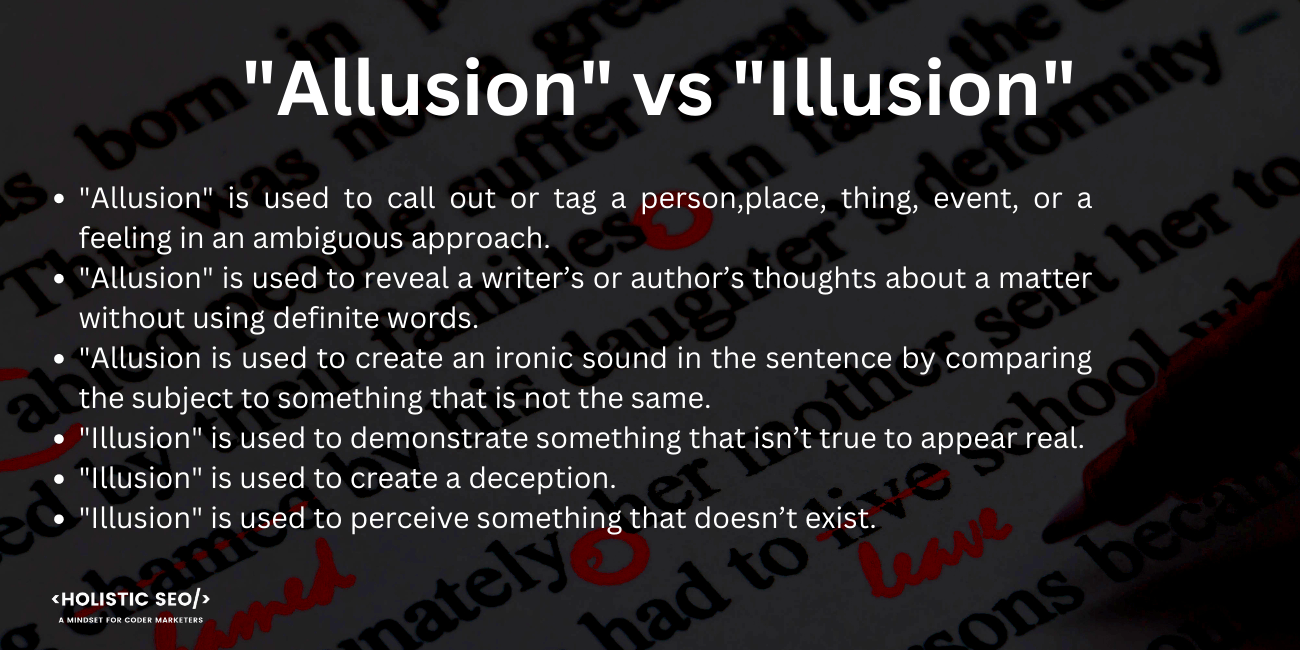
- “Allusion” is used to call out or tag a person,place, thing, event, or a feeling in an ambiguous approach.
- “Allusion” is used to reveal a writer’s or author’s thoughts about a matter without using definite words.
- “Allusion is used to create an ironic sound in the sentence by comparing the subject to something that is not the same.
- “Illusion” is used to demonstrate something that isn’t true to appear real.
- “Illusion” is used to create a deception.
- “Illusion” is used to perceive something that doesn’t exist.
Writers and speakers must consider the type of idea he/she wants to express in order to decide when to use “allusion” and “illusion.” The word” Allusion” is typically used in conveying ideas or thoughts in an obscured way. It uses names of characters or artifacts from famous movies, food names, and other adjectives in replace of simple and definite words. The term “Illusion” is normally used in demonstrating the unreal into something genuine. The word “Illusion” is utilized in sentences where the writer or speaker wants the listener or reader to perceive that something exists but isn’t.
The words “Allusion” and “Illusion” are often misused for their spelling and pronunciation. The only thing that makes them different from one another is their meaning as applied in a sentence. Some example sentences for the word “Allusion”are the following; “There are lots of literary echoes and allusions in the novel, but they don’t do anything for the tired texture of the prose.” and “The lyrics contain biblical allusions.” are a sentence example for the word “Allusion”. The word “Allusion” as used in the sentences, denotes the presence of sentences and ideas in the novel which indirectly refer to a subject using indefinite words and phrases. The word “Allusion” is grammatically correct as used in the sentences. The two example sentences use the word “Allusion” as a noun, although in plural forms. Meanwhile, some examples for the term “illusion” are as follows; “The video game is designed to give the illusion that you are in control of an airplane.”and “They used paint to create the illusion of metal.” The word “Illusion” as used in the sentences, denotes a perception or anticipation of something that doesn’t really exist. Notice the word “Illusion” and how it is used in the sentences. Illusion for control in the first sentence example and the illusion for a certain element, which as mentioned in the second sentence example, is metal. The word “Illusion” is grammatically correct as utilized in the sentence. It is in the form of a noun preceded by the word “the”.
Many content writers and speakers have been asking about “Why is there a need to know the difference between “Allusion” and “Illusion” for content writing and marketing? The reason for that is because it is very important to write better content and communicate in a healthier way in which readers can relate more effectively. Knowing the difference between “Allusion” and “Illusion” helps the writer or author to provide relevant and compelling ideas in a sentence. It is crucial to have the right vocabulary when it comes to content writing and marketing. A good written content lacks misused words and indefinite information. Knowing the difference between similar words or homophones , like for example, “Allusion” and “Illusion”, produces higher searchability and marketing revenue as a result.
What does “Allusion” Mean?
“Allusion” is the act of making an indirect reference to a person, place, thing or feeling. The etymology for the word “Allusion” is “Alludere”. It is derived from the Latin Verb “Alludere” which means “to play with”, “to jest”, or “to refer to”. It was borrowed and used for the English language in the 16th century. Allusion was defined as a “metaphor or parable” in the 1540s. It was named “allusionem” until changed to Allusion,in the early years of the 16th century. “Allusion” is “an indirect or passing reference to some event, person, place, or artistic work, the nature and relevance of which is not explained by the writer but relies on the reader’s familiarity with what is thus mentioned”, according to the Oxford Reference. The term “Allusion” is not a common word in English. It is normally associated with subjects pertaining to Poetry and Literature such as Novels, Mythology or the Bible. However, the term “allusion” is an important word for daily life because it is useful in the areas of written and oral literature commonly encountered in the academe. It is helpful for authors and writers who wish to deliver their craft in an indefinite way thus, creating more gripping contents. “Allusion” is a great tool for those people who decide to make indirect declarations of their thoughts, emotions or issues in life.
What are the sentence examples with “Allusion”?
The following are example sentences with the word “allusion”,
- “The author’s new novel holds an allusion to mythological gods.” The term “allusion” in the sentence denotes an indirect reference towards an entity. The sentence as a whole, implies that the author’s novel contains absurd sentences or words that pertain to mythological gods.
- “Although the president’s speech sounds original, it states an allusion to a speech made by another world leader.” The word “allusion “ in the sentence expresses an idea about the subject’s speech. Although stated indirectly, the sentence implies that the president’s speech is somehow related to another world leader’s.
- “Sofia included an allusion about her dog in her song.” The word “allusion” implies an indirect description about a certain entity, as used in the sentence. It means that the subject is describing her dog in the song using indefinite words and phrases, so as to make an allusion.
- “Even though the blog makes an allusion to the suspect’s identity, it never actually mentions the person’s name.” The sentence talks about a certain blog post having ambiguous illustrations towards a crime suspect. The word “allusion”, as stated in the sentence denotes an obscure referral about the person.
When to use the word “Allusion” in a sentence?
“Allusion” is used when the speaker wants to enhance the word/s being used in the sentence. Using Allusions in a sentence makes it appear more compelling. One uses an “allusion” when promoting an ironic comment on a specific matter by relating the subject to something that is not the same. It’s like tagging the exact opposite of the word being used. “Allusion” is sometimes used when revealing the unspoken ideas of the author. “Allusions” is an outlet for writers’ and authors’ thoughts that they cannot deliver in plain words. One of the synonyms for the word “Allusion” is “intimation”. It means a clue or hint or making known indirectly. Intimation is efficient for contexts such as describing the amount of things and explaining the situation.
How often is the word “Allusion” used in a sentence?
“Allusions” are commonly used in literature. Most allusions are based on the assumption that there is a body of knowledge that is shared by the author and the reader. Allusions are sometimes customary to depict the Bible and Greek mythology in traditional western Literature. Some authors of today’s era like T.S. Eliot and James Joyce are fond of obscure allusions as well,
What are the synonyms of “Allusion”?
The synonyms for the word “Allusion” include; “reference”, “implication,” and “insinuation.” The term “reference” means pertaining to the source. It serves as supporting information describing the origin from where the idea is taken. “Implication” means an idea that is indirectly conveyed. The word” Insinuation” denotes the act of insinuating. Some example sentences of these terms are “The lack of reference (allusion) in the author’s argument creates wonder if it can be proven or not.” , “He took issue with the implication (allusion) that he could not be trusted with the assignment.”, “I resent her insinuation (allusion) that I can’t do it without her help.” The word “reference” in the sentence pertains to the source of the author’s idea. It denotes that the origin of the author’s argument must be presented. The word “implication” pertains to the obscured idea regarding the subject’s trust issue. The speaker is trying to convey that the subject took hold of the indirect allegations against him/her. For the third sentence example, it implies an indirect allegation of the subject towards another person. the Variations in the words for the term “Allusion” are evident however, it depends upon the ideas that the author wants to convey. Some of the variations for the word “Allusion” include “Inference”, “Innuendo”, “Indication”, and “intimation”.
What does “Illusion” Mean?
“Illusion” refers to a misleading image presented to the vision similar to an Optical Illusion. It is something that deceives or creates a false impression perceived in the human mind. The word “Illusion” was first used in the 14th century which implies the action of deceiving. The etymology of the term illusion started from the Latin word “Illudere” and further developed into “Illusio” at the time of Old French. The word “Illusion” came to the surface at the time of MIddle English era and is still used up to this day. The word “Illusion” is a common word in English. It is much more used than the word” allusion”. Oftentimes, it is helpful in sentence declarations, metaphors, exaggeration, and description. While it is as common as the word “allusion”, “illusion” is an important word for daily life as well. It is vital because it is widely used among different contexts and in different spheres in society, whether in the academe, art, literature, and technology.
What are the sentence examples with “Illusion”?
The following are the sentence examples with the word “Illusion”.
- “In a small space, a mirror creates the optical illusion of a larger room.” The word “Illusion” as used in the sentence, implies an idea that a mirror allows a small room to look bigger. It’s because of the optical illusion that a mirror creates. The illusion makes the room wider and more spacious as it reflects light.
- “When looking at the illusion on the page, I saw both a woman’s head and a cat in the design. “The sentence above is another example of an optical illusion. Illusions are not just applied in interior design as mentioned in the first phrase example, it is used in printed materials such as books, magazines, Catalogs, and Newspapers as well. The second phrase example mentioned above suggests an illusion from a magazine which displays two images in one design. The real image is not determined because it depends on how the reader perceives the design.
- “She says that all progress is just an illusion.” The word “Illusion” in the sentence depicts a revelation regarding something that is not known to everyone. The writer is trying to imply that the subject reveals the genuinity of the progress which was believed to be present but actually is not.
- “From there, add a luminous foundation, highlighter and cream blush that gives the illusion of round, rosy cheeks.” Notice that the sentence speaks about make-up. The word “ illusion” in the sentence implies that a certain attribute is created out of a deception. The round rosy cheeks brought about by the highlighter is actually an illusion.
When to use the word “Illusion” in a sentence?
The word “Illusion” is specifically used in a sentence when conveying something that is not real but seems to be true. Using an illusion is helpful in conditions where one wants to promote a sense of deception to hide something. However, it is not great to use illusion when delivering real and true matters. A good synonym for the word “Illusion“ is “Deception”. Deception means misleading or being dishonest. The word “Deception” is used in the context of exaggeration, describing the amount of things, and explaining situations.
How often is the word “Illusion” used in a sentence?
The word “Illusion” is rarely used in a sentence. Unlike “Allusion”, it is not often utilized, since it is irrelevant to usual conversations. “Illusions” are included in sentences only to notify the reader that an “illusion” is made to the subject or that it took place. “Illusions” are often shown rather than said. Most “Illusions” are evident in pictures, designs, graphics, architecture, art and recreation sites like carnivals. However, ‘Illusions” are also related to the human mind. It particularly pertains to the word “Hallucination’. “Hallucination’ is a false interpretation of objects or events caused by chemical reactions and/ or abnormalities in the brain.
What are the synonyms of “Illusion”?
The most common synonyms for the word “Illusion” are, “Delusion”, “Hallucination”, and “Mirage”. These words come to the same meaning which is something that is perceived to be true but actually false. The word ‘Delusion” is more suitable to use when implying an inability to determine what is true and what seems true. “Delusion” is often a result of a tangled state of mind.The word “Hallucination” is appropriate to use when implying impressions of disordered senses caused by drugs or mental illness. “Mirage” is applicable when implying something that is a dream. The kind of ideas that exist only in the mind and are not true.
How is the pronunciation of “Allusion” and “Illusion”?
The words “Allusion” and “Illusion” are both pronounced /əˈluʒən/, with their first vowels being reduced to the unstressed schwa sound. The word “Illusion” is pronounced /ɪˈluʒən/ when spoken carefully. The difference between “Allusion” and “Illusion” are categorized into three; the spelling, the definition, and the pronunciation. Though they sound almost the same, the words “Allusion” and “Illusion” have different meanings. The more commonly heard word, “Illusion” means false, erroneous or deceitful. “Allusion” on the other hand, means indirect, obscure or ambiguous.
Comparison between “Allusion” and “Illusion”
Listed below is the table that shows the comparison between the words “allusion“ and “illusion.“
| Allusion | Illusion | |
| Definition | “Allusion” is the act of making an indirect reference to a person, place, thing or feeling. It is a figure of speech used to express something without mentioning it directly. | “Illusion” refers to a misleading image presented to the vision similar to an Optical “Illusion.” It is something that deceives or creates a false impression perceived in the human mind. |
| Contexts | “Allusions” are used in the context of enhancing the words used in the sentence.”Allusions” are used to reveal the author’s indefinite idea towards a topic using obscured words or phrases. | “Illusions” are used in the context of creating a deception to make something appear real or true.”Illusions” are used to conceal truth by presenting that is not. |
| Example Sentences | “Sofia included an allusion about her dog in her song.” “The author’s new novel holds an allusion to mythological gods.” | “When looking at the illusion on the page, I saw both a woman’s head and a cat in the design.” “In a small space, a mirror creates the optical illusion of a larger room.” |
Why are “Allusion” and “Illusion” misused interchangeably in English?
The terms “Allusion” and “Illusion” are misused interchangeably in English because of two reasons. The first reason why they are misused interchangeably is the spelling. It’s just a matter of a one letter difference. “Allusion” starts with the letter /A/. “Illusion”, on the contrary, starts with the letter /I/. These words have the same set of letters after /A/ and /I/ which is “llusion”. The similarity in the letters made it baffling. The second reason why they are misused interchangeably is the pronunciation. The trick comes from the first letter of each word again. The phonetic sounds of letters /A/ and /I/ are almost the same. The similar spellings and pronunciations of “allusion” and “illusion” cause writers and authors to second-guess. Even great writers and authors find it challenging to choose the right words to use. People learn them together and confuse themselves because the words “allusion” and “Illusion” are not used in normal conversation and in common English sentences. People do not encounter these words on a day-to-day basis making it difficult to remember their differences and similarities.
Are “Allusion” and “Illusion” the most commonly misused English words?
No, the words “Allusion” and “Illusion” are one of the most commonly misused English words. The most effective way to determine which word to use is to remember each grammar usage and purpose. The word “Allusion” is an indirect reference to a place, person, thing, event, or feeling using indefinite words or phrases. It is commonly used as a noun. Aside from being used as a noun, the word “allusion” is utilized as a verb using the word “allude”. The word “Illusion” is a process by which something that is not real appears to be true. It is commonly used as a noun as well. The ultimate guide to be able to use misused English words correctly is to keep in mind the meaning of the words. “Allusion” is an indirect referral to something while “illusion” is used for creating deception..
What are the other similar Misused Word Pairs like “Illusion” and “Allusion” in English?
Listed below are some other similar misused word pairs like “illusion“ and “allusion“ in English.
- “Accept” and “Except”: The words “Accept” and “Except” are similar to the word pair “Allusion“ and “Illusion” because they have almost the same spelling and pronunciation. The only difference between “Accept” and “Except” is their definition. “Accept” is a verb which means to receive something willingly. “Except” on the contrary, is often used as a pronoun which means “not including”.
- “Affect” and “Effect”: The word “Affect” and “Effect” are similar to “Allusion” and “Illusion. The words “Affect” and “Effect” differs in meaning but have almost the same spelling and pronunciation. The word “Affect’ means to create impact or change. The term “Effect” furthermore, pertains to the result of the change or action being made.
- “All ready” and “Already”: Both words have the same pronunciation but differ in the way they are spelled out. The presence of space and another letter “l’ in the word “All ready” makes it distinct from the word “already”. Both words have different definitions as well. “All ready” is a phrasal term which implies that something is prepared or done. “Already” means “by this time”. It is an adverb used to denote an intensive after a word to express impatience.
- “Altogether” and “All together”: They have the same pronunciation and almost the same spelling but have different meanings, just like the words “Allusion” and “illusion”. “Altogether” means completely or all things considered. The phrase “All together” on the other hand, means everyone or everything together.
What are the things should a content writer consider in using the words “Allusion” and “Illusion”?
The things that a content writer should consider in using the words “Allusion” and “Illusion” are as follows. The first factor that a content writer must consider is Grammar. Grammar is the study of classes of words, their functions, and relations in s sentence. It is very important for a content writer to know the correct word to use in terms of its grammar usage. A good content writer knows how to arrange the words and ideas to make proper sentences. The words “Allusion” and “Illusion” are nouns in the parts of speech. Nouns are used to indicate a person, place, thing, or event. Therefore, the words “Allusion” and “Illusion” are used to name something. It is not a word of action or an adjective. Their purpose and definition changes when the spelling is changed by removing some letters. Say for example, “allude”. “Allude” is the verb form of the word Allusion making it an action word. The reason why content writers need to consider grammar is to be able to deliver the right ideas in an effective way. The second factor to be considered is the Definition. Definition is very important for a content writer. It is difficult to use the right word if the meaning of the word is not apprehended. A good content writer knows how to use words according to their meaning. Content writers bear in mind that ‘ ‘Allusion ” means an indirect reference to a person, thing, place, or feeling using obscure words or phrases. “Illusion”, furthermore, means an act of creating a deception by making something look as it is but actually not.
Can content writers use “Allusion” and “Illusion” in one sentence?
Yes, content writers are allowed to use “Allusion” and “Illusion” in one sentence. The word “And” is a conjunction designed to connect words that are presented in one sentence. However, there are things that a writer or author needs to remember when using the words “Allusion” and “Illusion” in one sentence. These words must be of the same level. They must be both nouns, or verbs, or adverbs. The words “Allusion” and “Illusion” are both nouns, which suggests that they can be used in a single sentence. The next thing to consider is how the writer or author arranges his/her ideas to come up with a good sentence.
How do Content Writers use “Allusion” and “Illusion” in their articles?
Content Writers use “Allusion” and “Illusion in their articles through having enough knowledge and experience of the words. Knowledge of the word boils down to two main ideas, being able to understand the true definition of the word and knowing how to use it in the sentences. A seasoned content writer knows how to use words in content writing according to their meaning. The word “Allusion” is used when referring to something indirectly using indefinite words. The term “Illusion” is used when conveying a touch of deception towards the readers. Content writers know the difference between “Allusion” and “Illusion”. Content writers perceive the right timing when to use the words individually or altogether. He/she knows the right format or level of speech of the words to be used in the sentences.
Do Content Writers use “Allusion” and “Illusion” in the wrong way?
No, content writers are not using the words “allusion” and “Illusion” in the wrong way. However, for beginners, content writing can be confusing. Not all content writers are adept with words. Some content writers require more experience and training. Professional content writers are the ones who are knowledgeable of the words used in their sentences, specifically with regards to using the words “Allusion” and “Illusion’. A good content writer perceives the importance of knowing the difference between almost identical word pairs, and being able to determine the right moment to utilize them. A seasoned content writer can never go wrong in creating good quality articles because of these factors.
Do Misused Words such as “Illusion” and “Allusion” affect SEO and UX?
Yes, misused words such as “Allusion” and “Illusion” affect SEO and UX. Misused words lowers the content quality of a certain website. As for SEO and UX, content quality is the superb indication of a great, crawlable and leading website on the internet. SEO or Search Engine Optimization is the process which allows a website to be more visible to people when searching for specific matters on the internet. UX stands for User experience. It is the interaction between the users and the company’s product and interface. The visibility of a website is poor when the content quality is poor. Optimizing the content helps pages to increase searchability and ranking in the search results.

- 48 Online Shopping and Consumer Behavior Statistics, Facts and Trends - August 22, 2023
- B2B Marketing Statistics - August 22, 2023
- 38 Podcast Statistics, Facts, and Trends - August 22, 2023